Claude Desktop (Cowork) Integration
Claude Desktop on third-party inference sends every model call from Cowork, Chat, and Code sessions to a gateway you name, and LiteLLM is that gateway: unified logging, per-user and per-team budgets, model access control, and any Claude deployment behind it (Anthropic, Bedrock, Vertex AI, Foundry) without touching the client again. This page covers the two ways a device authenticates to LiteLLM, single sign-on through your identity provider (nothing to hand out or rotate, spend attributed to the person) and a static virtual key (the quickest way to try it), then what shows up in the model picker, how the same identity reaches MCP servers through the LiteLLM MCP gateway, how to ship the configuration to a fleet, and what to check when something does not work.
How it fits together
Claude Desktop treats LiteLLM the way it treats Anthropic's own API: it discovers models with GET /v1/models at launch and sends chat traffic to POST /v1/messages with streaming and tool use, carrying Authorization: Bearer <credential> on every request. The credential is either a LiteLLM virtual key or, with single sign-on, the ID token your identity provider issued to the signed-in user, which LiteLLM validates with JWT auth on every request and maps to a LiteLLM user and teams.
| Setting | Value |
|---|---|
| Gateway base URL | https://your-litellm-proxy.com, no /v1 suffix |
| Credential, single sign-on | the user's ID token, validated by LiteLLM JWT auth |
| Credential, static key | a LiteLLM virtual key |
| Endpoints used | GET /v1/models, POST /v1/messages, and POST /mcp for MCP servers |
| LiteLLM version | v1.98.0 or later for model discovery, v1.89.0 or later for the issuers JWT config |
| Claude Desktop version | 1.6889.0 or later for single sign-on (2.7032.0 or later for the external-idp key names), 1.10628.0 or later for the claude.ai import |
Option A: Single sign-on with your identity provider
With single sign-on (inferenceCredentialKind: interactive, which Claude Desktop 2.7032.0 and later also accept as external-idp), Claude Desktop runs an OpenID Connect sign-in (authorization code with PKCE) in the system browser against your identity provider, keeps the refresh token in OS secure storage, and sends the ID token to LiteLLM as the bearer credential. LiteLLM checks the signature against the provider's signing keys, the issuer, and the audience, then maps the token's claims to a LiteLLM user and, through a groups claim, to LiteLLM teams. Nobody provisions or rotates keys, a user removed from the identity provider loses access when the token expires, MFA and conditional access apply, and the only thing the user sees is a Sign in to your organization button. This path needs a database behind LiteLLM, because users and spend are written to it.
1. Register Claude Desktop in your identity provider
Claude Desktop is a native app, so it registers as a public client (PKCE, no client secret) with a loopback redirect URI.
- Microsoft Entra ID
- Okta
- AWS Cognito
In the Entra admin center create an app registration for accounts in your directory only, then under Authentication add a Mobile and desktop applications platform with the custom redirect URI http://127.0.0.1/callback. Use 127.0.0.1 rather than localhost, keep the /callback path, and add it under that platform specifically: it is the only one Entra lets use any local port, which the app needs because it picks a free port at sign-in time. No client secret or API permissions are needed. Copy the Application (client) ID and Directory (tenant) ID.
The issuer is https://login.microsoftonline.com/YOUR_TENANT_ID/v2.0 and the signing keys are at https://login.microsoftonline.com/YOUR_TENANT_ID/discovery/v2.0/keys. The stable user id claim is oid. To map users to LiteLLM teams by group, add a groups claim to the ID token under Token configuration; it carries group object ids.
In the Okta admin console create an app integration of type OIDC, Native Application with the Authorization Code and Refresh Token grant types. Okta matches the redirect URI exactly, port included, so pick a fixed port such as 53180, register http://127.0.0.1:53180/callback, and set the same port in Claude Desktop below. Assign the users or groups who should get access.
The issuer is https://YOUR_ORG.okta.com, the plain org URL rather than the metadata URI ending in /.well-known/openid-configuration (a custom authorization server's issuer is https://YOUR_ORG.okta.com/oauth2/AUTH_SERVER_ID), and the signing keys are at https://YOUR_ORG.okta.com/oauth2/v1/keys. The stable user id claim is sub. Add a groups claim to the ID token for team mapping.
In the Cognito console open your user pool and create an app client with the Mobile app application type. That is the console's public client type (PKCE, no client secret), and it is the one a desktop app needs: the Traditional web application type generates a client secret, Cognito then demands that secret on every token request, Claude Desktop never sends one because it is a public client, and a secret cannot be removed after creation, so sign-in with a web-type client always dies at token exchange. Cognito matches the redirect URI exactly, port included, so pick a fixed port such as 53180, enter http://127.0.0.1:53180/callback as the return URL (Cognito allows plain http for 127.0.0.1), and set the same port in Claude Desktop below.
After creation, open the app client's Login pages configuration and enable the OpenID Connect scopes openid, profile, and email. The user pool also needs a domain under Branding > Domain, because Cognito's authorize and token endpoints live on that domain; the discovery document at the issuer URL points to them automatically.
The issuer is https://cognito-idp.REGION.amazonaws.com/USER_POOL_ID and the signing keys are at https://cognito-idp.REGION.amazonaws.com/USER_POOL_ID/.well-known/jwks.json. The stable user id claim is sub, and group memberships arrive in the cognito:groups claim for users in user pool groups.
2. Configure LiteLLM to validate the token
Describe the identity provider to LiteLLM with an issuers entry (LiteLLM v1.89.0 or later). Each entry binds one iss value to its signing keys and audience and carries that provider's claim names, so several providers can sit side by side. The audience is the client id you registered: an ID token's aud is the client it was issued to, and checking it is what stops a token minted for some other app in the same tenant from reaching your gateway.
- Microsoft Entra ID
- Okta
- AWS Cognito
general_settings:
  enable_jwt_auth: true
  litellm_jwtauth:
    user_id_upsert: true
    issuers:
      - issuer: https://login.microsoftonline.com/YOUR_TENANT_ID/v2.0
        jwks_url: https://login.microsoftonline.com/YOUR_TENANT_ID/discovery/v2.0/keys
        audience: YOUR_CLIENT_ID
        user_id_jwt_field: oid
        user_email_jwt_field: email
        team_ids_jwt_field: groups

model_list:
  - model_name: claude-sonnet-5
    litellm_params:
      model: anthropic/claude-sonnet-5
      api_key: os.environ/ANTHROPIC_API_KEY
  - model_name: claude-opus-5
    litellm_params:
      model: anthropic/claude-opus-5
      api_key: os.environ/ANTHROPIC_API_KEY
  - model_name: claude-haiku-4-5
    litellm_params:
      model: anthropic/claude-haiku-4-5
      api_key: os.environ/ANTHROPIC_API_KEY
general_settings:
  enable_jwt_auth: true
  litellm_jwtauth:
    user_id_upsert: true
    issuers:
      - issuer: https://YOUR_ORG.okta.com
        jwks_url: https://YOUR_ORG.okta.com/oauth2/v1/keys
        audience: YOUR_CLIENT_ID
        user_id_jwt_field: sub
        user_email_jwt_field: email
        team_ids_jwt_field: groups

model_list:
  - model_name: claude-sonnet-5
    litellm_params:
      model: anthropic/claude-sonnet-5
      api_key: os.environ/ANTHROPIC_API_KEY
  - model_name: claude-opus-5
    litellm_params:
      model: anthropic/claude-opus-5
      api_key: os.environ/ANTHROPIC_API_KEY
  - model_name: claude-haiku-4-5
    litellm_params:
      model: anthropic/claude-haiku-4-5
      api_key: os.environ/ANTHROPIC_API_KEY
general_settings:
  enable_jwt_auth: true
  litellm_jwtauth:
    user_id_upsert: true
    issuers:
      - issuer: https://cognito-idp.REGION.amazonaws.com/USER_POOL_ID
        jwks_url: https://cognito-idp.REGION.amazonaws.com/USER_POOL_ID/.well-known/jwks.json
        audience: YOUR_CLIENT_ID
        user_id_jwt_field: sub
        user_email_jwt_field: email
        team_ids_jwt_field: cognito:groups

model_list:
  - model_name: claude-sonnet-5
    litellm_params:
      model: anthropic/claude-sonnet-5
      api_key: os.environ/ANTHROPIC_API_KEY
  - model_name: claude-opus-5
    litellm_params:
      model: anthropic/claude-opus-5
      api_key: os.environ/ANTHROPIC_API_KEY
  - model_name: claude-haiku-4-5
    litellm_params:
      model: anthropic/claude-haiku-4-5
      api_key: os.environ/ANTHROPIC_API_KEY
This validates the ID token, the default bearer. If you set bearerTokenType: access_token in Claude Desktop instead, replace audience: YOUR_CLIENT_ID with disable_audience_validation: true, because Cognito access tokens carry a client_id claim but no aud claim; LiteLLM refuses a config that sets both keys on one entry.
jwks_url is optional: without it LiteLLM reads jwks_uri from {issuer}/.well-known/openid-configuration. Either way LiteLLM fetches the signing keys from the identity provider over the network, so the proxy needs outbound HTTPS to it from wherever it runs; in a locked-down VPC, allow that egress or the first authenticated requests fail waiting for keys. user_id_upsert: true creates the LiteLLM user on first request, so spend accrues per person under Internal Users and the oid or sub value lands on every spend log row; user_allowed_email_domain: yourcompany.com refuses tokens from any other email domain. team_ids_jwt_field: groups turns the token's group memberships into LiteLLM team memberships: create a team whose team_id equals the group's id (an Entra group object id, an Okta group name) and that team's models, max_budget, rate limits, and MCP server permissions apply to everyone in the group. LiteLLM adds the user to the team the first time a token carries that group, so they also show up under the team's members, and a user who belongs to exactly one team keeps resolving to it even when a later token omits the claim. A token whose groups match no team is still accepted as the user, with no team budget and no MCP servers, so drop the line if you do not need teams. A token whose iss matches no entry falls back to the JWT_PUBLIC_KEY_URL, JWT_AUDIENCE, and JWT_ISSUER environment variables, which is the single-provider setup JWT auth describes and works here too.
public_key_url and audience are not litellm_jwtauth keysAnthropic's gateway guide shows litellm_jwtauth with public_key_url and audience directly under it. LiteLLM has no such keys and refuses to start with ValueError: Invalid arguments provided: ... naming public_key_url and audience. Put them in an issuers entry as above, or set JWT_PUBLIC_KEY_URL and JWT_AUDIENCE as environment variables.
3. Configure Claude Desktop
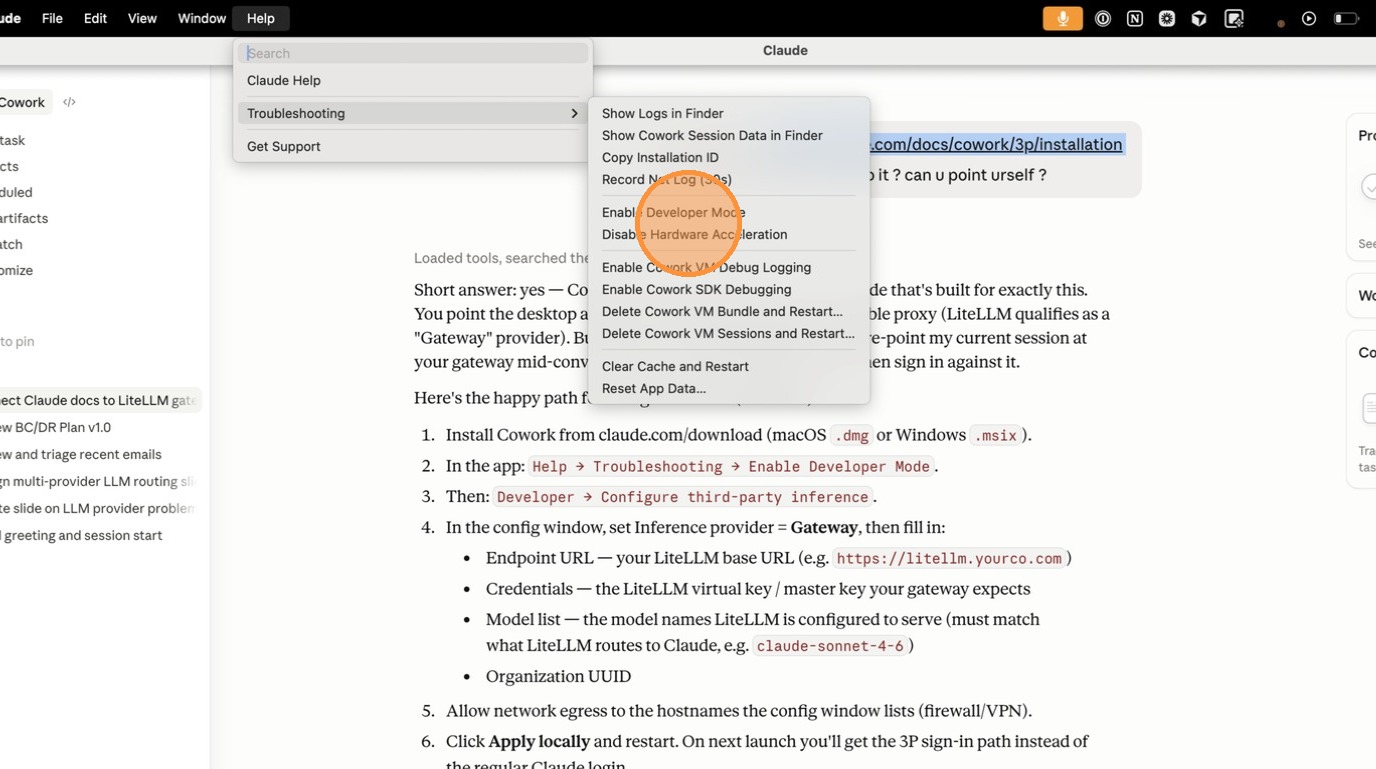
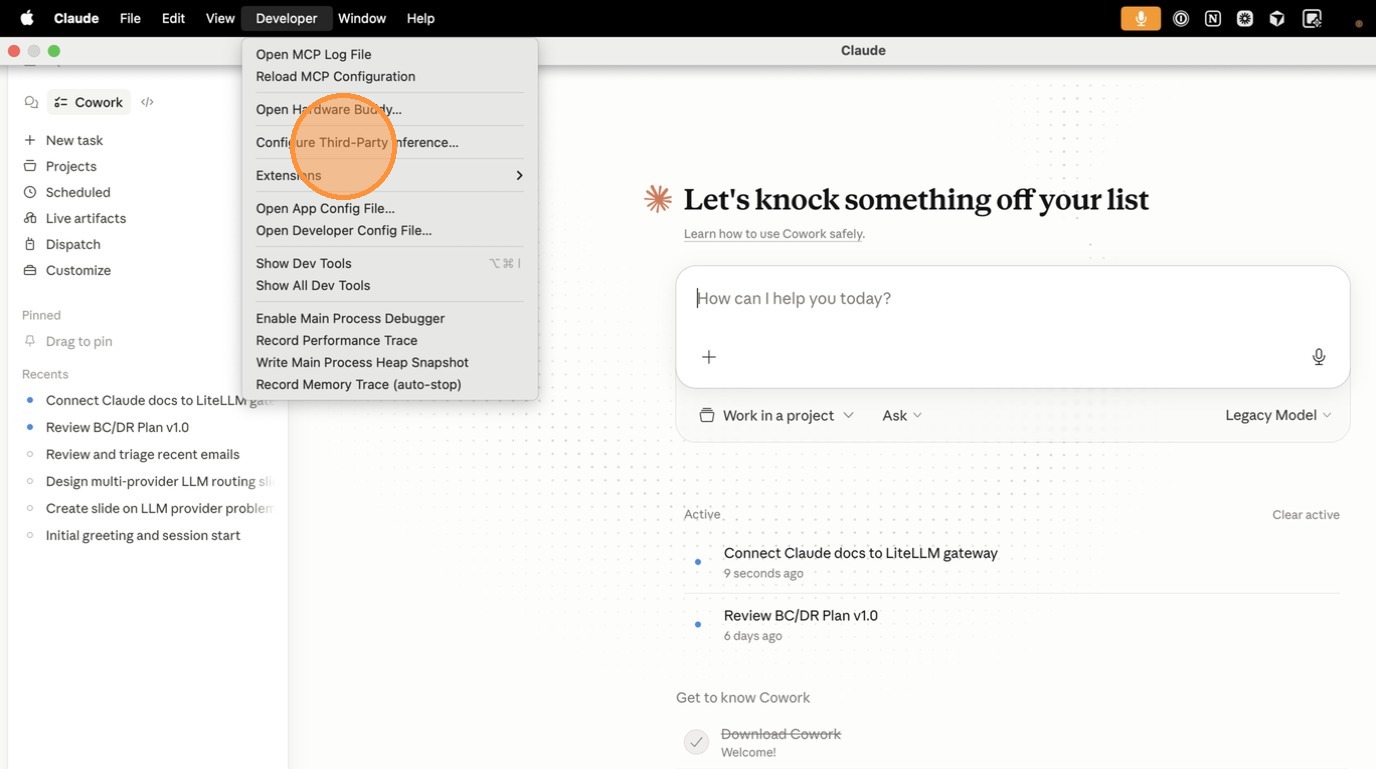
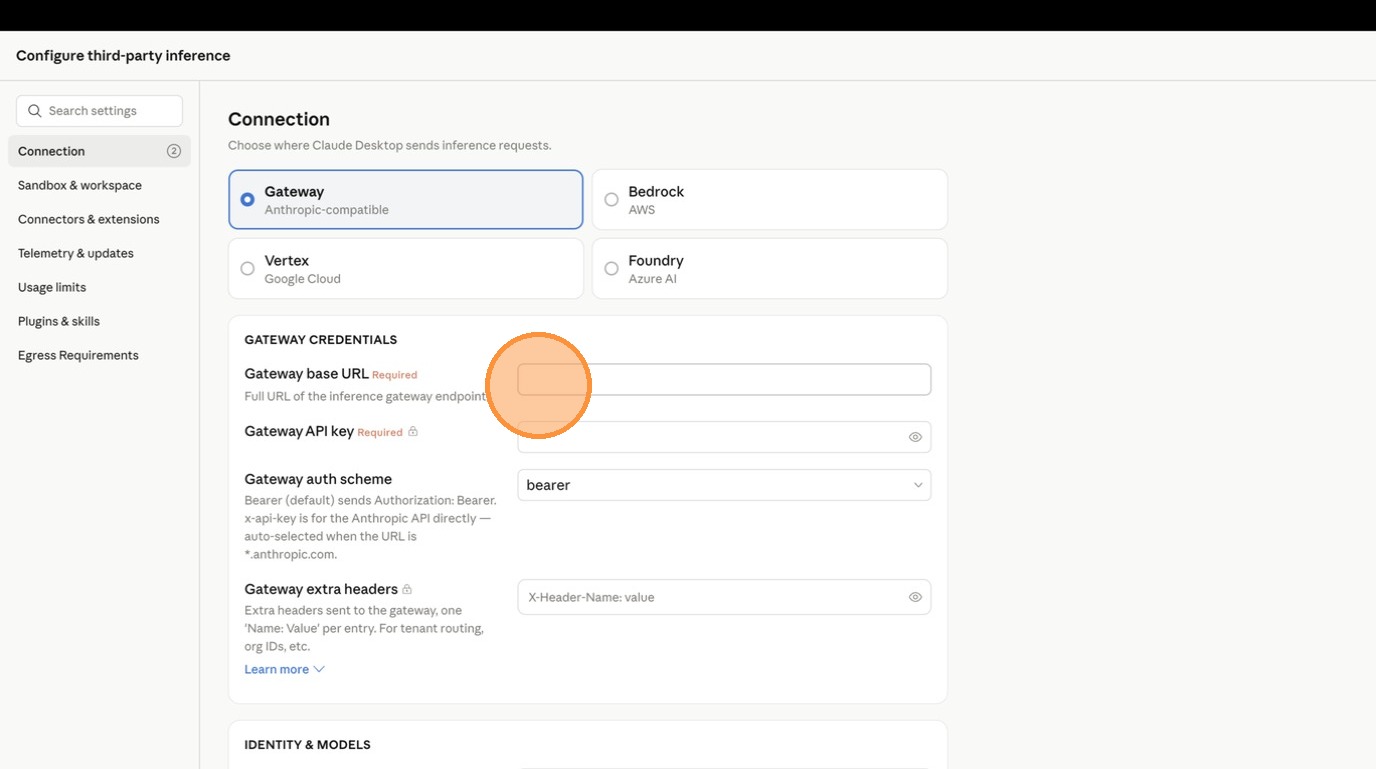
Open the configuration window: Help > Troubleshooting > Enable Developer Mode, then Developer > Configure Third-Party Inference…. In the Connection section set Inference provider to Gateway, Gateway base URL to your proxy URL, and Credential kind to Interactive sign-in, which hides the API key field and reveals Gateway SSO IdP (OIDC): enter the Client ID and Issuer URL from step 1, leave Scopes empty for the default openid profile email offline_access (except with Cognito: set it to openid profile email explicitly, since Cognito has no offline_access scope and fails the sign-in with invalid_scope when one is requested; Cognito issues refresh tokens regardless), and fill Redirect port for Okta and Cognito (53180). Apply Changes writes the configuration for this device, which is enough to try it out; Export produces the managed configuration for a fleet (see Rolling out to a fleet).
The exported keys, in a macOS .mobileconfig payload:
<key>inferenceProvider</key>
<string>gateway</string>
<key>inferenceGatewayBaseUrl</key>
<string>https://your-litellm-proxy.com</string>
<key>inferenceCredentialKind</key>
<string>interactive</string>
<key>inferenceGatewayOidc</key>
<string>{"issuer":"https://login.microsoftonline.com/YOUR_TENANT_ID/v2.0","clientId":"YOUR_CLIENT_ID"}</string>
For Okta the JSON is {"issuer":"https://YOUR_ORG.okta.com","clientId":"YOUR_CLIENT_ID","redirectPort":53180}; for Cognito it is {"issuer":"https://cognito-idp.REGION.amazonaws.com/USER_POOL_ID","clientId":"YOUR_CLIENT_ID","redirectPort":53180,"scopes":"openid profile email"}. inferenceGatewayOidc is one key whose value is a JSON string (a REG_SZ on Windows, a native object in Linux's managed-settings.json); dotted keys such as inferenceGatewayOidc.clientId are never read. Leave bearerTokenType at its default id_token, which is what the issuers entry validates; Google Workspace needs access_token there, because it issues no fresh ID token on refresh and re-prompts users about hourly otherwise.
The same JSON also takes redirectHost: "localhost", which moves the callback to http://localhost:PORT/callback for an identity provider whose registered redirect URI uses localhost. On Entra, inferenceGatewayOidcAuthFlow: broker signs in through the OS identity broker (Web Account Manager on Windows, Company Portal on macOS) instead of the browser, which satisfies Conditional Access policies that require a managed device; the app registration then also needs the broker redirect URIs ms-appx-web://Microsoft.AAD.BrokerPlugin/YOUR_CLIENT_ID and msauth.com.anthropic.claudefordesktop://auth under the same platform, and Linux has no broker.
Claude Desktop 2.7032.0 renamed these keys: inferenceCredentialKind: external-idp with the JSON in inferenceIdpOidc, and inferenceIdpAuthFlow in place of inferenceGatewayOidcAuthFlow. The keys above keep working with no end date set and newer releases read them as external-idp, so keep them until every device in the fleet runs 2.7032.0 or later; the in-app window still labels the choice Interactive sign-in. A profile left over from an older setup that sets inferenceGatewayAuthScheme: sso has to replace it with inferenceCredentialKind before October 7, 2026, after which the app reports that value as invalid and, with no other credential key present, starts the gateway connection with no credential.
4. Verify
On the next launch the user sees Sign in to your organization, signs in through the browser, and lands back in the app with the model picker filled from your proxy. In the LiteLLM UI, Logs shows each request under the user's id, and Internal Users shows the upserted user with spend. The same endpoints can be exercised from a shell with any ID token your provider issues for that client id:
curl https://your-litellm-proxy.com/v1/models \
  -H "Authorization: Bearer $ID_TOKEN" -H "anthropic-version: 2023-06-01"

curl -N https://your-litellm-proxy.com/v1/messages \
  -H "Authorization: Bearer $ID_TOKEN" -H "anthropic-version: 2023-06-01" -H "content-type: application/json" \
  -d '{"model":"claude-sonnet-5","max_tokens":64,"stream":true,"messages":[{"role":"user","content":"hello"}]}'
The first returns the Anthropic-shaped model list the picker is built from; the second streams a reply. A 401 with Audience doesn't match means the token was issued to a different client id than the one in audience; Missing JWT Public Key URL from environment. means the token's iss matched no issuers entry; Token Expired is the state the app resolves on its own by refreshing the token, or by prompting Sign in again when the refresh fails.
Option B: Static virtual key
A virtual key is the right credential for a proof of concept, a shared workstation, or a gateway that already hands out per-team keys. Everyone on the same managed profile shares that key and its budget, and rotating it means pushing a new profile, which is why fleets end up on single sign-on.
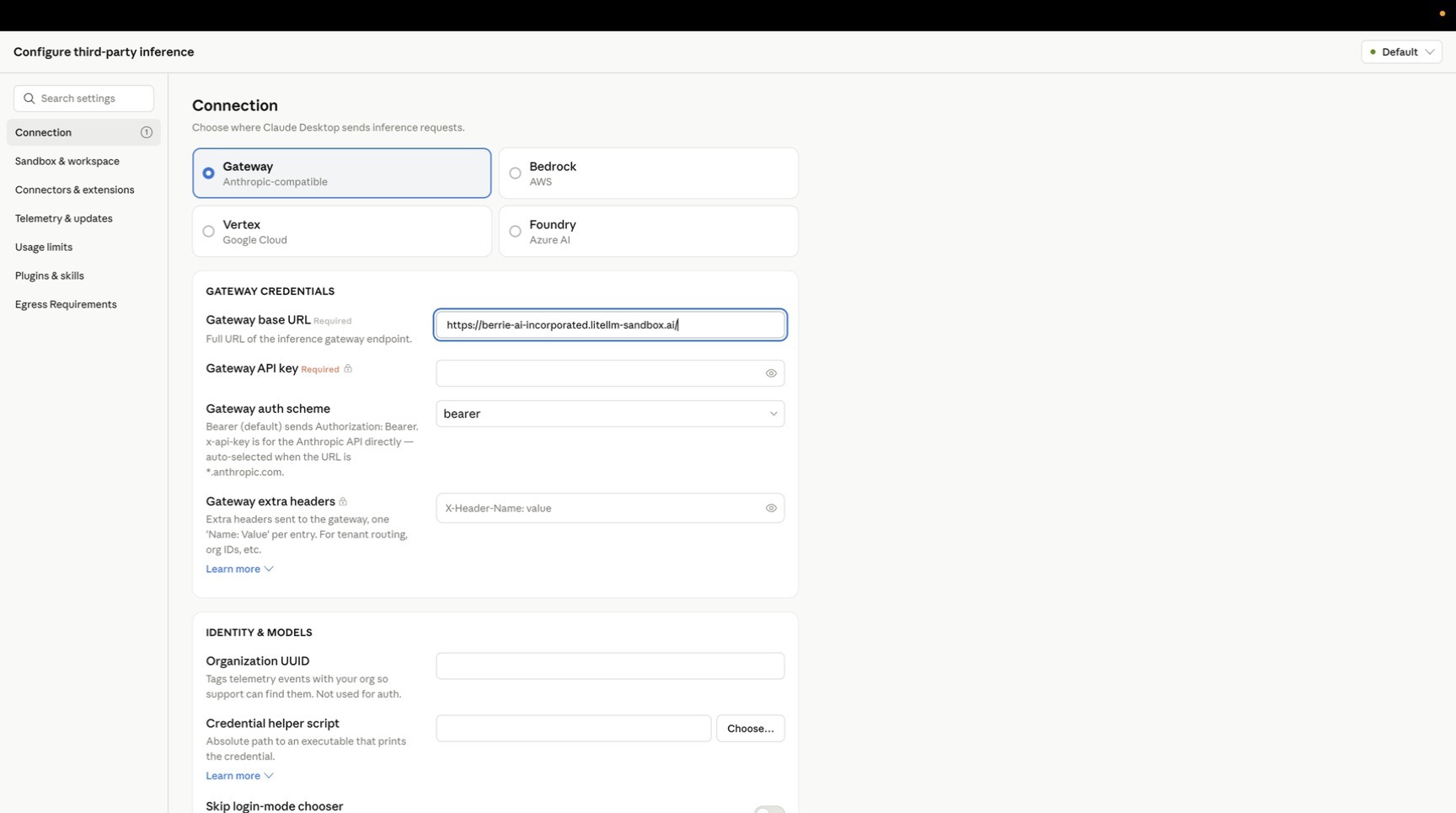
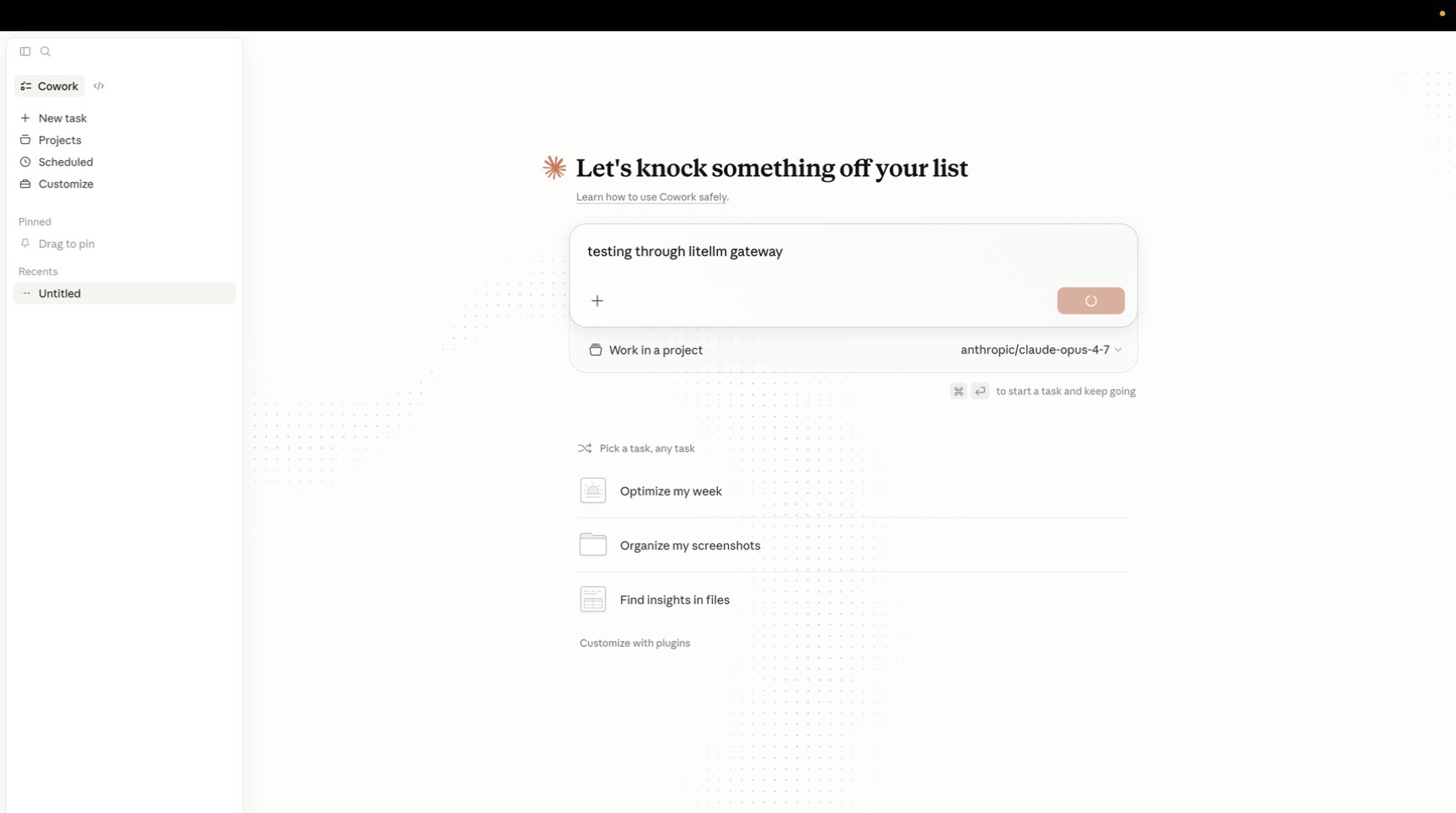
Create the key in the LiteLLM UI under Virtual Keys > + Create New Key, scoped to the Claude models with a max_budget, and copy it. In Claude Desktop, enable Developer Mode under Help > Troubleshooting, open Developer > Configure Third-Party Inference…, set Inference provider to Gateway, enter the Gateway base URL and the key as the Gateway API key, keep Credential kind at Static API key and Gateway auth scheme at Bearer (LiteLLM also accepts x-api-key), and click Apply Changes.
The exported form is inferenceProvider: gateway, inferenceGatewayBaseUrl, and inferenceGatewayApiKey, with inferenceGatewayAuthScheme: x-api-key only if you chose that scheme. Requests then show up under that key in Logs and Usage.
Models in the picker
Claude Desktop builds the picker from GET /v1/models and keeps only ids that contain claude or anthropic, case-insensitively, so the model_name values in your model_list are what matter, not the upstream ids behind them: claude-sonnet-5 served from Bedrock or Vertex AI passes, smart-router does not. LiteLLM does not return the anthropic_family_tier field that would let an opaque alias through the filter, so either put claude in the name or list the model in inferenceModels, which replaces discovery with exactly the entries you give (the first is the default). What LiteLLM does return on each model is display_name, which is the model_name unless the deployment sets model_info.display_name, and max_input_tokens from the model's info; the app treats a discovered model whose max_input_tokens is 1,000,000 or more as 1M-capable, so claude-sonnet-5 and claude-opus-5 get their 1M picker entry from discovery alone. A hand-written inferenceModels list looks like this:
[
  {"name": "claude-sonnet-5", "supports1m": true},
  {"name": "claude-opus-5", "labelOverride": "Opus 5 via LiteLLM"},
  {"name": "claude-haiku-4-5"}
]
supports1m adds a second, 1M-context picker entry for that model (the string shorthand "claude-sonnet-5[1m]" means the same); set it only on a name that exactly matches the id your proxy returns and only for deployments that accept 1M-token requests, and add prefer1m: true to make the 1M entry the default selection. anthropicFamilyTier (sonnet, opus, haiku, fable, mythos) with isFamilyDefault: true tells the app which entry a bare tier alias resolves to. Organizations on Claude for Teams or Enterprise also need each gateway model name on their availableModels allowlist, or it shows greyed out; Auto Router with Claude Code and Claude Desktop covers the allowlist rules and how to put an auto router behind a name the picker accepts. Non-Claude models behind LiteLLM work the same way once their model_name contains claude; add drop_params: true to those entries so the Anthropic-specific request fields Cowork and Code sessions send are dropped where the provider has no equivalent instead of failing the request.
MCP servers through the LiteLLM MCP gateway
Managed MCP servers on Claude Desktop are managedMcpServers entries, and pointing them at LiteLLM's MCP gateway instead of at each upstream server keeps MCP traffic under the same logging, access control, and identity as inference. LiteLLM exposes every configured server on one streamable HTTP endpoint, https://your-litellm-proxy.com/mcp, authenticated with the same bearer credential; the x-mcp-servers header narrows one entry to specific servers (the per-server path /mcp/<server_name> does the same), and tools appear as <server>-<tool>.
mcp_servers:
  deepwiki:
    url: https://mcp.deepwiki.com/mcp
    transport: http
  github:
    url: https://api.githubcopilot.com/mcp
    transport: http
    auth_type: bearer_token
    auth_value: os.environ/GITHUB_TOKEN
Access to a server is granted rather than assumed: a signed-in user sees only the servers their team, key, or organization is permitted to use, and every other server is simply absent from tools/list. With single sign-on the grant lives on the team the token's groups map to, so create that team with the servers in its object_permission (the same call sets the models and budget the group gets):
curl -X POST https://your-litellm-proxy.com/team/new \
  -H "Authorization: Bearer $LITELLM_MASTER_KEY" -H "content-type: application/json" \
  -d '{"team_id": "GROUP_ID_FROM_THE_TOKEN", "team_alias": "Claude Desktop users",
       "models": ["claude-sonnet-5", "claude-opus-5", "claude-haiku-4-5"], "max_budget": 500,
       "object_permission": {"mcp_servers": ["deepwiki", "github"]}}'
A low-risk server can instead be opened to everyone with allow_all_keys: true (Public MCP servers), and MCP access control covers access groups and per-tool permissions. On the Claude Desktop side, a static virtual key goes in the entry's headers:
[
  {
    "name": "litellm",
    "transport": "http",
    "url": "https://your-litellm-proxy.com/mcp",
    "headers": {"Authorization": "Bearer sk-...", "x-mcp-servers": "deepwiki,github"}
  }
]
Static headers cannot carry a signed-in user's own token, so single sign-on fleets use headersHelper instead: an executable Claude Desktop runs that prints the headers as a flat JSON object, re-run on the headersHelperTtlSec schedule and again when the server answers 401 or 403 (Claude Desktop 1.46388.1 or later). A helper that obtains an ID token for the same app registration keeps chat and MCP spend on the same LiteLLM user. toolPolicy, a map of tool name to allow, ask, or blocked, sets the confirmation policy per tool. Servers that need the user's own upstream login (GitHub, Atlassian, and the like) take "oauth": true against the per-server URL https://your-litellm-proxy.com/mcp/<server_name> with LiteLLM's MCP OAuth passthrough or the gateway-hosted DCR bridge; Claude Desktop starts that sign-in only when the server answers an unauthenticated request with HTTP 401, on the loopback callback http://127.0.0.1:53280/callback. A server marked available_on_public_internet: false is hidden from callers outside the private ranges (or the mcp_internal_ip_ranges you set), so a laptop on the public internet sees only the rest (MCP servers on the public internet).
Claude Desktop's built-in connectors ("server": "microsoft365", "github", "websearch") run inside the app against those vendors' own APIs and never pass through LiteLLM; only url entries do. To keep GitHub or Microsoft 365 traffic under LiteLLM, configure the vendor's MCP server as an mcp_servers entry on the proxy and point a url entry at it.
On gateway deployments Claude Desktop keeps MCP tool search off, so every tool schema from every server is inlined into each request, and a session with many MCP tools compacts every turn or two. toolSearchEnabled: true (Claude Desktop 1.21459.0 or later) loads schemas on demand instead; requests then carry the tool-search-tool-2025-10-19 value in anthropic-beta, deferred tool loading, and tool_reference content blocks, which LiteLLM forwards to Anthropic deployments on /v1/messages.
Rolling out to a fleet
Export in the configuration window turns what you applied into the template your MDM expects: a .mobileconfig (macOS), a .reg file or ADMX (Windows), or Intune OMA-URI JSON. Managed configuration is read from /Library/Managed Preferences/<user>/com.anthropic.claudefordesktop.plist on macOS, HKLM\SOFTWARE\Policies\Claude (or HKCU) on Windows, and /etc/claude-desktop/managed-settings.json on Linux, while Apply Changes writes to ~/Library/Application Support/Claude-3p/configLibrary/, %LOCALAPPDATA%\Claude-3p\configLibrary\, and ~/.config/Claude-3p/configLibrary/. bootstrapUrl lets devices fetch the same configuration from a server you host instead of an MDM profile; LiteLLM does not serve a bootstrap endpoint today. Anthropic's Enterprise Admin Console, in beta, is a third route with no profile or server to run: Anthropic hosts the configuration, and each user's app downloads the settings for their group after they sign in once with a work-email Claude account. A device whose MDM profile sets any key other than the update keys ignores the console.
Two more keys matter behind LiteLLM. inferenceCustomHeaders, a JSON object of extra headers sent on every inference and discovery request (routing and tenant headers only, never credentials), is how a profile stamps x-litellm-tags on every request, which tag budgets, tag routing, and the Usage page all group by; {"x-litellm-tags": "claude-desktop,finance"} gives a department its own budget without a separate key or team. inferenceStreamIdleTimeoutSec (300 to 1800) extends how long a Cowork or Code session waits for model output on a streaming response, but only when LiteLLM writes SSE keep-alive pings while the upstream model is silent, which is off by default; sse_keepalive_ping_interval_seconds: 15 under litellm_settings turns it on for every deployment (keepalive pings). A response with nothing on it still times out at the default.
Bringing users' claude.ai chats over
A user who moves from a personal Claude subscription to the gateway starts with an empty sidebar. Standard Claude Desktop keeps chats on claude.ai under that account, while Claude Desktop on third-party inference has no Anthropic account and keeps Chat and Cowork history on the device, under ~/Library/Application Support/Claude-3p/ on macOS. The switch deletes nothing: the old chats stay readable at claude.ai, and the two modes coexist on one machine, so the Anthropic option on the sign-in screen brings the standard app back without touching the gateway data. They just do not show up in the gateway app on their own.
Anthropic ships an import for exactly this move, off by default. Add claudeAiImport to the managed configuration (an MDM profile or a bootstrap response, which is where Anthropic's reference says the key is read from), and chatTabEnabled unless Chat is already on, since the Chat surface is off by default on third-party inference. claudeAiImport is one key whose value is a JSON object, the same form as inferenceGatewayOidc above (a JSON string in a .mobileconfig or .reg, a native object in a bootstrap response or managed-settings.json), on Claude Desktop 1.10628.0 or later:
{
  "chatTabEnabled": true,
  "claudeAiImport": {"enabled": true, "exportEnabled": true, "bannerBehavior": "show"}
}
bannerBehavior is what makes the move self-serve: show puts a prompt to import at the top of a new chat or task, so nobody has to know the settings page exists, and detect shows it only on machines that hold sessions from an earlier Claude install. Leave it unset and the app shows no prompt.
Each user then opens Settings > Import & export, clicks Import…, and signs in to claude.ai from the wizard; Fetch export pulls their chats and projects and copies them into the gateway app. Users who would rather not sign in from the app download the zip from Settings > Privacy > Export data on claude.ai (the emailed link lasts 24 hours) and pick it with Choose file…, and the same wizard picks up Cowork and Code sessions left on the machine by an earlier standard install. An imported chat opens from the sidebar and continues against your proxy after Trust and resume. The import is a one-time copy that can be rerun without creating duplicates, attachments and project knowledge files never come over (a claude.ai policy that applies to both paths), and members of a claude.ai Team or Enterprise workspace can only export once an owner turns on Allow members to export their own data under the workspace's data and privacy settings. exportEnabled adds Export… to the same settings page, a zip of this computer's chats and sessions for moving to another device through the same wizard. Anthropic's import guide has screenshots of each step.
Prompt caching
Cowork and Code sessions send cache_control breakpoints on every turn so the provider reuses the tool definitions, system prompt, and earlier turns instead of billing them again as fresh input, and LiteLLM forwards them on /v1/messages. After the first request of a session, the usage on most responses should show cache_read_input_tokens well above zero. Zero on every turn means something ahead of a breakpoint changes between requests, typically a callback or guardrail that rewrites the system prompt or the tool list per request, so check what runs on the route that serves the Claude models.
Usage attribution
Under single sign-on every request is attributed to the LiteLLM user upserted from the token, and to the team when a groups claim maps to one, so Usage breaks spend down by person and by team and budgets apply at both levels. Under a static key the key is the unit, and one key per team or per purpose with its own max_budget is the practical granularity. Either way, x-litellm-tags from inferenceCustomHeaders adds a third axis, such as a department or cost center, without changing who authenticates.
Troubleshooting
The model picker is empty, or the connection test passes but no Claude model appears. Discovery keeps only ids containing claude or anthropic; rename the model_name or set inferenceModels. LiteLLM older than v1.98.0 answers /v1/models in OpenAI shape only, which the app cannot parse; upgrade, or set inferenceModels so the app skips discovery.
Sign-in succeeds and the tab closes, but GET /v1/models answers 401. The proxy has no enable_jwt_auth: true under general_settings, so the bearer token fell through to virtual key auth and failed the key lookup; sign-in still looks fine because the browser step only involves the identity provider. Recent LiteLLM versions say so in the 401 body: "This key has the structure of a JWT, but JWT auth is not enabled on this proxy". Add the JWT config from step 2.
The browser lands on the identity provider's own error page with redirect_mismatch. The callback is not registered on the client, or the provider matches the port exactly while Claude Desktop picked an ephemeral one. Register http://127.0.0.1:PORT/callback with a fixed port and set that port as Redirect port; Okta and Cognito both match exactly.
Sign-in bounces straight back to 127.0.0.1 with error=invalid_request&error_description=invalid_scope (Cognito). The request asked for a scope the app client does not have. Either Scopes was left empty, so the default set requested offline_access, which Cognito does not support, or the OIDC scopes are not enabled on the app client's Login pages configuration. Set Scopes to openid profile email and enable those three on the app client.
Authentication Error, Missing JWT Public Key URL from environment. on every request. The token's iss matched no issuers entry (compare the iss claim in the token with the issuer value; Entra tokens carry /v2.0 at the end) and no JWT_PUBLIC_KEY_URL fallback is set.
ValueError: Invalid arguments provided naming public_key_url and audience at startup. The config followed Anthropic's snippet. Move those values into an issuers entry.
Authentication Error, Validation fails: Audience doesn't match. The token was issued to a different client id; audience must be the client id of the Claude Desktop app registration, and bearerTokenType must be left at id_token, since an access token's audience is the API it was requested for.
Token Expired, or users are asked to sign in every hour. Refresh needs the offline_access scope, which the default scopes include; a custom scopes value in id_token mode must list it explicitly. Google Workspace re-prompts hourly in id_token mode regardless; use bearerTokenType: access_token there.
gateway SSO: server does not advertise device_authorization_endpoint. The app could not read inferenceGatewayOidc (or inferenceIdpOidc), usually because it was pushed as dotted keys or invalid JSON. Re-export from the configuration window.
OIDC discovery failed (HTTP 404) or (HTTP 405). The issuer value is the metadata URI instead of the issuer base URL; remove the /.well-known/openid-configuration suffix.
The browser shows Connected but the app reports Token exchange failed (HTTP 401). The identity provider registration is a confidential (Web) client expecting a secret. Register a Native application (Okta), a Mobile and desktop applications platform (Entra), or a Mobile app client (Cognito) instead; the client type cannot be changed after creation, and a Cognito client secret cannot be removed after creation, so create a new client.
GET /v1/models was unreachable or timed out right after enabling JWT auth, on a gateway that answered instantly before. The first validated request makes the proxy fetch the signing keys from jwks_url, and blocked egress from the proxy's network to the identity provider stalls that fetch. From inside the proxy container, curl -m 5 <jwks_url> should return the key set; if it hangs, open that egress.
tools/list on the LiteLLM MCP endpoint comes back empty. The signed-in user has no grant on any server: the token's groups match no team, or the team's object_permission lists no mcp_servers. Add the servers to the team or set allow_all_keys: true on the server.
Requests to a non-Claude model fail with 400. Cowork and Code sessions send Anthropic-specific fields; set drop_params: true on that model_list entry.
The 1M context window entry is missing. With discovery, the model's max_input_tokens in LiteLLM's model info is below 1,000,000. With inferenceModels, supports1m sits on an entry whose name does not match the id your proxy returns exactly.
A user who moved from a personal Claude subscription to the gateway sees none of their old chats. Nothing was deleted; the chats live on claude.ai under that account, and the gateway app keeps its own local history. Turn on claudeAiImport and have the user run Settings > Import & export > Import… (Bringing users' claude.ai chats over).
Settings > Import & export says import is not enabled for this deployment. claudeAiImport is missing from the managed configuration or its enabled is not true; a managed profile on the device wins over anything applied locally, so the key has to be in the profile.
Related
- JWT auth for every
litellm_jwtauthoption, including role mappings and JWT-to-virtual-key mapping - Virtual keys
- MCP gateway, MCP access control, and MCP OAuth passthrough
- Auto Router with Claude Code and Claude Desktop
- Claude Code with LiteLLM
- Anthropic's gateway guide, configuration reference, MCP servers and extensions, and import guide for Claude Desktop on third-party inference