Sentry
This is community maintained, Please make an issue if you run into a bug https://github.com/BerriAI/litellm
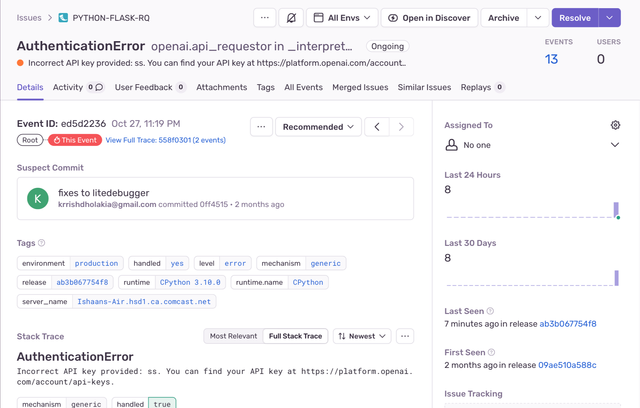
Sentry provides error monitoring for production. LiteLLM can add breadcrumbs and send exceptions to Sentry with this integration
Track exceptions for:
- litellm.completion() - completion()for 100+ LLMs
- litellm.acompletion() - async completion()
- Streaming completion() & acompletion() calls
Usage
Set SENTRY_DSN & callback
import litellm, os
os.environ["SENTRY_DSN"] = "your-sentry-url"
litellm.failure_callback=["sentry"]
Sentry callback with completion
import litellm
from litellm import completion

litellm.input_callback=["sentry"] # adds sentry breadcrumbing
litellm.failure_callback=["sentry"] # [OPTIONAL] if you want litellm to capture -> send exception to sentry

import os
os.environ["SENTRY_DSN"] = "your-sentry-url"
os.environ["OPENAI_API_KEY"] = "your-openai-key"

# set bad key to trigger error
api_key="bad-key"
response = completion(model="gpt-6-luna", messages=[{"role": "user", "content": "Hey!"}], stream=True, api_key=api_key)

print(response)
Sample Rate Options
-
SENTRY_API_SAMPLE_RATE: Controls what percentage of errors are sent to Sentry
- Value between 0 and 1 (default is 1.0 or 100% of errors)
- Example: 0.5 sends 50% of errors, 0.1 sends 10% of errors
-
SENTRY_API_TRACE_RATE: Controls what percentage of transactions are sampled for performance monitoring
- Value between 0 and 1 (default is 1.0 or 100% of transactions)
- Example: 0.5 traces 50% of transactions, 0.1 traces 10% of transactions
These options are useful for high-volume applications where sampling a subset of errors and transactions provides sufficient visibility while managing costs.
Sentry Environment
- SENTRY_ENVIRONMENT: Specifies the environment name for your Sentry events (e.g., "production", "staging", "development")
- Helps organize and filter errors by deployment environment in Sentry dashboard
- Example:
os.environ["SENTRY_ENVIRONMENT"] = "staging" - If not set, Sentry will use 'production' as the default environment
PII and secret scrubbing
By default LiteLLM sends Sentry events with send_default_pii off and scrubs them before they leave the proxy, so the frame locals Sentry attaches to an exception never carry credentials or user identity
Secrets are always removed. API keys (any sk- value, wherever it appears), the request headers a virtual key arrives in (Authorization, x-api-key, api-key, x-goog-api-key, x-litellm-api-key), the master key, the database URL, tokens, cookies, and passwords read [Filtered] whether they sit in a top-level variable, in a nested dict such as general_settings, or inside the repr of an object such as UserAPIKeyAuth(token='...')
User identity is removed unless you opt in. user_id, user_email, end_user_id, the hashed virtual key (user_api_key_hash), and the user_api_key_* metadata fields read [Filtered] in the same three places, and any email-shaped value or 64-character hex key hash left elsewhere in the event is replaced too
Set SENTRY_SEND_DEFAULT_PII=true when you want Sentry to show which user or key an error belongs to. The identity fields then pass through while secrets stay filtered
export SENTRY_SEND_DEFAULT_PII=true
Redacting Messages, Response Content from Sentry Logging
Set litellm.turn_off_message_logging=True This will prevent the messages and responses from being logged to sentry, but request metadata will still be logged.
Let us know if you need any additional options from Sentry.