Langtrace
Open-source observability and evaluations for LLM applications, at langtrace.ai.
Pre-Requisites
uv add litellm
Langtrace ingests OTLP at a custom path (/api/trace) with an x-api-key header, whereas OpenTelemetry v2 exports to /v1/traces with no Langtrace credentials. With LITELLM_OTEL_V2=true, run an OpenTelemetry Collector between them: litellm exports to the collector, and the collector forwards the spans to Langtrace with your key. The langtrace preset applies Langtrace's attribute schema; the collector only handles delivery, which is why LANGTRACE_API_KEY lives in the collector's environment rather than the proxy's
Without LITELLM_OTEL_V2, the langtrace callback posts directly to https://app.langtrace.ai/api/trace with LANGTRACE_API_KEY set on the proxy as the x-api-key header, no collector needed. Set LANGTRACE_API_HOST to the base URL of a self-hosted Langtrace (for example https://langtrace.example.com) and the callback posts to <host>/api/trace. See the proxy logging guide for that setup
Quick Start
- SDK
- LiteLLM Proxy
import litellm
import os

os.environ["LITELLM_OTEL_V2"] = "true"
os.environ["OTEL_ENDPOINT"] = "http://otel-collector:4318"
# LLM API Keys
os.environ["OPENAI_API_KEY"] = ""

# set langtrace as a callback, litellm will send the data to langtrace
litellm.callbacks = ["langtrace"]

# openai call
response = litellm.completion(
  model="gpt-5.6-terra",
  messages=[
    {"role": "user", "content": "Hi 👋 - i'm openai"}
  ]
)
- Setup config.yaml
model_list:
  - model_name: gpt-5.6-terra
    litellm_params:
      model: openai/gpt-5.6-terra
      api_key: os.environ/OPENAI_API_KEY

litellm_settings:
  callbacks: ["langtrace"]
- Point litellm at your collector
LITELLM_OTEL_V2=true
OTEL_ENDPOINT="http://otel-collector:4318"
- Configure the collector
otel-collector-config.yaml, with LANGTRACE_API_KEY set in the collector's environment:
receivers:
  otlp:
    protocols:
      http:
        endpoint: 0.0.0.0:4318
exporters:
  otlphttp/langtrace:
    encoding: json
    compression: none
    traces_endpoint: https://app.langtrace.ai/api/trace
    headers:
      x-api-key: ${env:LANGTRACE_API_KEY}
      Content-Type: application/json
service:
  pipelines:
    traces:
      receivers: [otlp]
      exporters: [otlphttp/langtrace]
- Start LiteLLM Proxy
litellm --config /path/to/config.yaml
- Test it!
curl -L -X POST 'http://0.0.0.0:4000/v1/chat/completions' \
-H 'Content-Type: application/json' \
-H "Authorization: Bearer $LITELLM_API_KEY" \
-d '{
  "model": "gpt-5.6-terra",
  "messages": [
    {
      "role": "user",
      "content": "Hey, how are you?"
    }
  ]
}'
What Langtrace renders
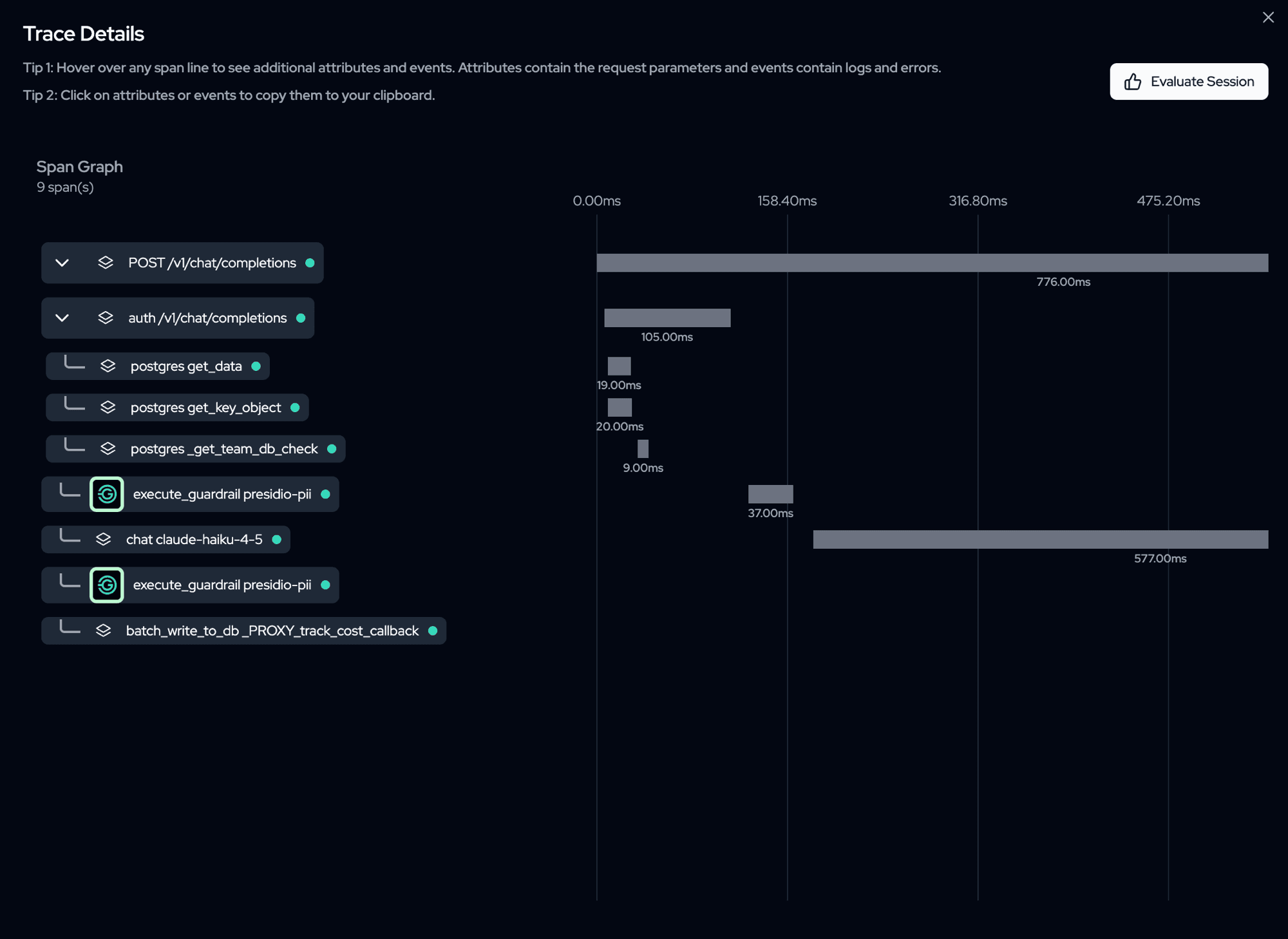
Open the Langtrace UI; the spans flow through your collector carrying the langtrace.* and llm.* keys alongside the canonical gen_ai.* ones.
The langtrace mapper adds langtrace.service.name for the provider, request and response identifiers (llm.model, gen_ai.response.model, gen_ai.response_id, gen_ai.system_fingerprint), the request params (llm.temperature, top_p, top_k, max_tokens, frequency_penalty, presence_penalty), the llm.stream flag, the llm.token.counts.* usage split, and llm.prompts / llm.completions when content capture is on. See the full attribute table.
Full OpenTelemetry reference
This page covers the Langtrace-specific setup. For span attributes, prompt and response capture, metrics, distributed tracing, and which routes are traced, see the OpenTelemetry v2 guide.
Support & Talk to Founders
- Schedule Demo 👋
- Community Discord 💭
- Our emails ✉️ ishaan@berri.ai / krrish@berri.ai